
Key Insight: Every operations function gravitates toward what its core systems demand. Under traditional CRMs, that meant RevOps had to fight off the identity of system admins and data cleaners. AI-native CRMs re-balance that gravitational pull so that RevOps can operate strategically as revenue architects.
How Identity Forms Around the Wrong Work
8 years ago, I found myself doing the most basic version of CRM data work inside a global company: assigning account hierarchies with manual Google searches and a spreadsheet for batch loading.
I soon expanded to tackle distributor data stewardship, then all account master data for the Americas. I did that because I could see that clean data was the foundation for an increasingly capable team - one with the ability to connect our data to decisions about territories, forecasts, and go-to-market design.
I was after a true revenue operations function.
That meant a strategic identity for that function, not just a mandate to keep the CRM clean. But keeping data from regressing consumed an inordinate proportion of my daily work. New data streamed in from every angle as we developed systematic governance to slow it down. Duplicates compounded. Hierarchies drifted from reality.
We could not outpace a system that generated bad data faster than it could be cleaned.
I found ways to push forward, iteratively transforming how the company managed distribution data, redesigning processes, tightening logic in whatever margin I could find. But that work happened in the cracks. The strategic roadmap never got dedicated capacity.
And this is where identity erosion begins: not in a single dramatic moment, but in the accumulation of days where the only work that fits is maintenance. When a function spends years doing maintenance work, the organization stops seeing it as anything else. The identity follows the work, not the charter.
Demand-Driven vs. Purpose-Driven Identity
Most organizations take a short-sighted view when measuring the impact of AI on systems admin and data maintenance work. The default is to consider how many hours can be saved, or even how much “resource efficiency” can be achieved. But in the case of RevOps, the real impact is measured by what the function becomes.
RevOps teams that spend the majority of their capacity on system and data stewardship lose more than time; they lose their organizational identity. And it’s not because the team stops caring about strategy, but because the system never stops demanding maintenance. The “data janitor” label describes a real organizational outcome: a function whose identity is heavily influenced by what its tools require of it rather than what the business needs from it.
The Moment Identity Almost Shifted
Several years went by like this, with mostly data and system admin work, before resourcing actually improved. A global initiative to standardize business systems across regions created the business case for two new FTEs. For the first time, there was a plausible path to a different identity for the team’s function. Enough hands to hold the line on data quality and begin staffing the strategic roadmap.
That is not what happened.
The FTEs were justifiably hired for ongoing data quality, not strategy. Together, we rewired the data model, cleaned the account base, and established governance that held. We succeeded.
Then came the reallocation: one FTE to the ops team, still underwater with day-to-day demands, and the other stayed in data stewardship.
A heroic effort of leadership might have forced a different allocation. But the system had spent years making the maintenance identity the overwhelmingly visible one. When the opportunity for a strategic allocation finally came, the decision instead confirmed how the team would always be perceived.
The Pattern
That tendency to default to a known identity is not unique to one company or team. Every strategic resource, when asked to also manage a system or resolve data quality, has to resist being fully absorbed into maintaining it.
Once absorbed, regaining the strategic function is a monumental task. “RevOps” becomes a catchphrase, another trend that came and went, falling off the roadmap not because it was deprioritized, but because no one can see the team doing that work anymore.
In RevOps, strategy should drive the technologies that in turn accelerate it. But that feedback loop can’t exist when the team responsible for strategy is pinned to maintenance.
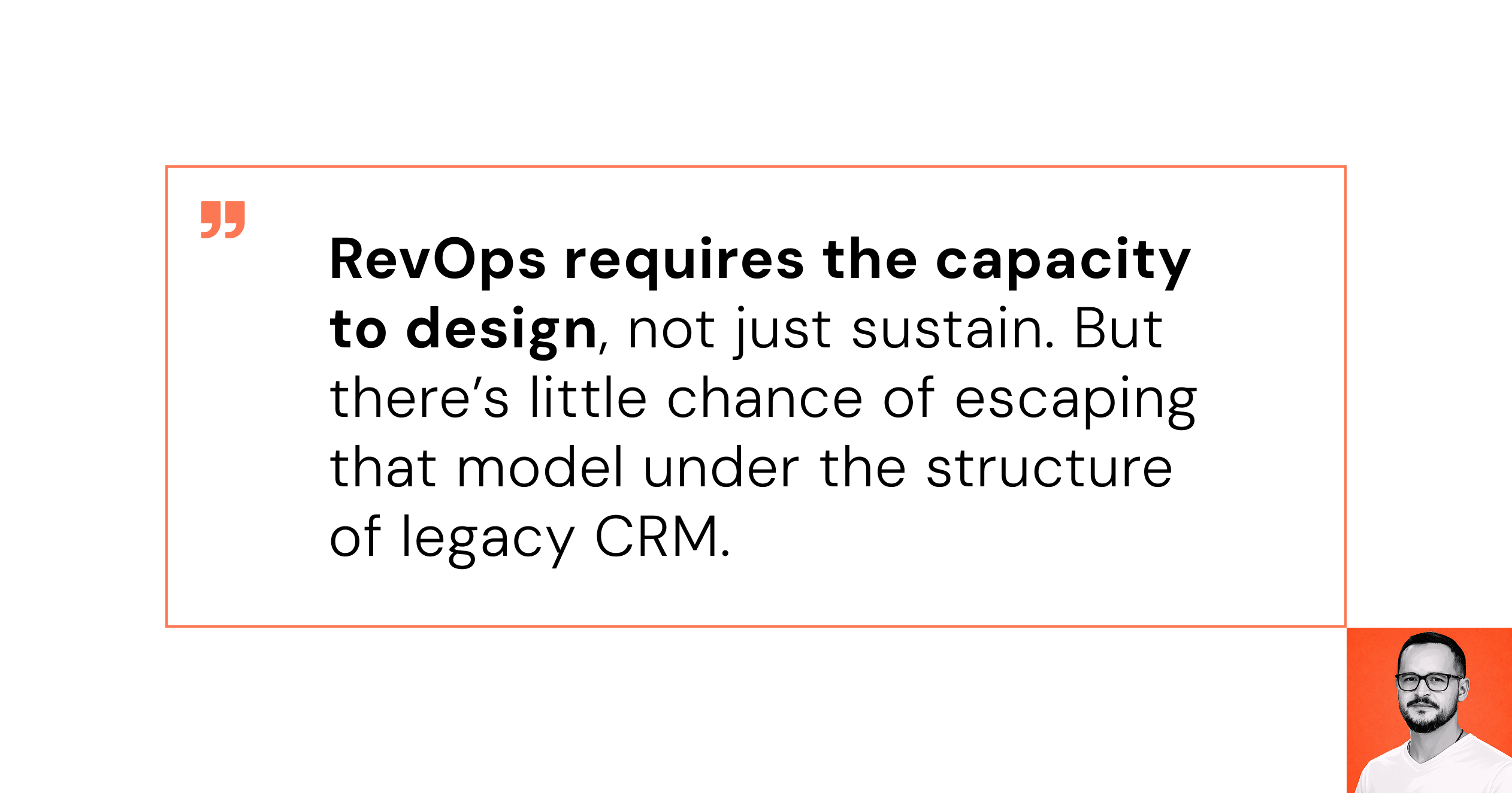
True RevOps is a function that has capacity to design, not just sustain.
Without that feedback loop, over time what’s expected of the team, even internally, quietly adjusts to match the reality of the day-to-day work. The function becomes what the system made it.
The Structural Precondition for a Different Identity
This is the context that makes revenue technology, and AI-native CRMs as a tier-one example, significant to this conversation. When baseline maintenance is automated, the RevOps function is no longer defined by what the system demands.
The data transformation I spent years squeezing into the cracks finally gets real capacity. Instead of manually reconciling account hierarchies, the team can build the territory model that connects ICP scoring to pipeline velocity. They can design the feedback loop between win/loss data and GTM motion, not because someone made a heroic case for it, but because the system stopped consuming every resource the function was given.
AI-native CRMs change what the function can become despite challenging seasons like transformation initiatives, acquisitions, and platform migrations. When the maintenance layer is automated, resources can be allocated to the strategic roadmap instead of the maintenance machine.
The team’s identity forms around revenue architecture instead of around the activities that support it.
And the organization starts evaluating RevOps on what it was designed to deliver.
The Real Question
A fundamental challenge has always been the operating model: a CRM architecture that required constant human intervention to remain functional, layered on top of an organization that expected the same team to also be strategic. Those expectations were incompatible - until now.
The question was whether the systems would catch up. They have. What’s left now is the decision to stop being the team that keeps the CRM clean, and to become the team that designs how revenue works.
RevTech Insights
Stay ahead of the GTM curve
Expert takes on GTM strategy, RevOps, and revenue architecture. Free, no spam.